Online store
WooCommerce vs Shopify in Latvia: which is better for your online store?
For a store that sells in Latvia and the Baltics, WooCommerce usually costs less: Omniva has its own plugin for parcel lockers, and the platform takes no extra fee on bank link payments. Shopify fits better if you do not want to look after the server, updates and security yourself, but on the Basic plan it takes 2% on payments through an outside payment provider.
WooCommerce vs Shopify: which is cheaper for a store in Latvia?
We build on WooCommerce ourselves and have not built Shopify stores, so what we write about Shopify comes from its official pages, which we opened on 25 October 2026.
If you sell mainly in the Baltics and your customers pay by bank link, WooCommerce can come out cheaper, because the platform takes no fee, and it has more local modules. If your store is small, you sell by card and you do not want to think about a server, Shopify is simpler. Shopify prices are in US dollars, because that is how its Latvian pricing page shows them too; we did not find euro prices.
| Parameter | WooCommerce | Shopify | Better for |
|---|---|---|---|
| Platform price | Plugin is free; hosting, domain and work are paid separately | Basic USD 29 per month billed yearly (USD 39 billed monthly); hosting included | Depends on hosting and work costs |
| Fee for an outside payment provider, such as bank links | No platform fee, you pay only the payment provider | Basic 2%, Grow 1%, Advanced 0.6%, Plus 0.2% of every transaction | WooCommerce |
| Latvian language | WooCommerce Latvian translation is 39% complete (stable version, translate.wordpress.org, 25 October 2026) | You can add the language, but there are no ready translated checkout texts in Latvian (Shopify Help Center, 25 October 2026) | Check for your own store |
| Parcel lockers (Omniva, DPD, Venipak) | Omniva's own plugin; Montonio modules | Usually through another company's app, for example from USD 15 per month | WooCommerce |
| VAT | You set rates by country in the store | Shopify Tax or manually set rates; Shopify does not file taxes for you | In both, you and your accountant file |
| Data | Store and database on your hosting | Product export as a CSV file; images are not in the file | WooCommerce |
| Maintenance and security | Updates, plugins and hosting are up to you or your contractor | Included in the subscription | Shopify |
| Launch speed for a small store | With us within a week, up to about 100 products (from €1,000) | 3-day trial, then USD 1 per month for 3 months (on most plans) | Shopify, if you build it yourself |
| robots.txt and pages | Fully in your hands | Changed with the robots.txt.liquid template | Possible in both, more freedom in WooCommerce |
| When it does not fit | If nobody looks after updates and security | If a large share of revenue goes through an outside payment provider | Depends on your store |
How much do WooCommerce and Shopify cost, and what are the fees?
The WooCommerce plugin is free, Shopify is a monthly subscription. Billed yearly, Shopify plans cost USD 29 (Basic), USD 79 (Grow) and USD 299 (Advanced) per month; billed monthly, USD 39, 105 and 399. Plus starts at USD 2,300 per month. With WooCommerce you pay separately for hosting, the domain, the extensions you need and the work.
In the Baltics the biggest difference is not the subscription but the fee for an outside payment provider. Shopify takes it on every transaction that goes through another company's payment system: 2% on Basic, 1% on Grow, 0.6% on Advanced and 0.2% on Plus. It applies to all such transactions even when Shopify Payments is turned on (the exception is PayPal, when Shopify Payments is the main system). WooCommerce has no platform fee.
An example by the formula: if €10,000 a month goes through bank links, the platform fee on the Basic plan is €200. This comes on top of the payment provider's fee; we do not count that fee or the dollar exchange rate.
Card fees: WooPayments in the euro area, including Latvia, takes 1.50% + €0.25 per card, with no monthly fee for online payments. Shopify Payments online takes 2.9% + 30 cents (Basic), 2.7% + 30 cents (Grow), 2.5% + 30 cents (Advanced) and 2.25% + 30 cents (Plus). These rates are in dollars; we did not find euro rates for Latvia.
Our WooCommerce store costs from €1,000 and is ready within a week if you have up to about 100 products and standard payments and delivery: online store development.
| Item | WooCommerce | Shopify |
|---|---|---|
| Platform per month | 0 (free plugin) | USD 29 / 79 / 299 billed yearly; Plus from USD 2,300 |
| Fee for an outside payment provider | None | 2% / 1% / 0.6%; Plus 0.2% |
| Online card payment | WooPayments: 1.50% + €0.25 | Shopify Payments: from 2.9% + 30 cents (Basic) to 2.25% + 30 cents (Plus) |
| Hosting and updates | Paid separately | Included |
| Example: €10,000 a month through bank links | €0 to the platform | €200 to the platform (Basic, 2%) |
Does Shopify work in Latvian?
You can add Latvian to a Shopify store, but you have to translate part of the texts yourself. The Basic, Grow and Advanced plans allow up to 20 languages, Plus up to 30.
Per the Shopify Help Center on 25 October 2026, Latvian is not among the 33 languages in which the checkout page is already translated. You can translate these texts yourself or add them with an app. Before you choose Shopify, check this in your own admin panel.
Automatic translation with the Shopify app Translate & Adapt gives 2 languages for most countries and 8 languages only for a list of 12 countries, and Latvia is not on it. For a store with Latvian as the main language and English and Russian as extra languages, two automatic translations are just enough.
The WooCommerce Latvian translation is 39% complete (stable version, translate.wordpress.org, 25 October 2026), so here too part of the texts will need checking and translating. Our base store is in one language; each extra language is extra work.
Which payment and delivery options work in Latvia?
Both platforms can take payments and deliver to parcel lockers; what differs is who provides it. Latvia is on the Shopify Payments and WooPayments country lists. We have not checked what exactly Shopify Payments accepts in Latvia, whether bank links or only cards and wallets.
Montonio lists integrations with WooCommerce and Shopify on its site, as well as PrestaShop, Magento, OpenCart and other platforms. It says it works with all popular banks in Estonia, Latvia, Lithuania and Poland and offers delivery with Omniva, DPD, Unisend, SmartPosti, Venipak, Latvijas Pasts and others. Shipping starts at €1.99 per parcel; with your own carrier contract there can be a fee of €5 per month per carrier. We have not checked how the Montonio module works in a Shopify store; ask Montonio about that.
Omniva has published its own plugin for WooCommerce stores and a manual for it (October 2024). We did not find an official Omniva app for Shopify. A Shopify store usually adds parcel lockers with another company's app: for example, ShipWisely shows Omniva, Venipak and DPD lockers for USD 15 per month up to 250 shipments or USD 29 per month up to 1,500 shipments, and it needs your own contract with the carrier.
When you connect your bank's payment links or another payment system, ask the provider which plugin or app it maintains for your platform. On Shopify, remember the fee.
| Solution | WooCommerce | Shopify |
|---|---|---|
| Card payments | WooPayments, Latvia on the list | Shopify Payments, Latvia on the list |
| Montonio (banks, cards, delivery) | Integration listed | Integration listed; ask Montonio for details |
| Omniva parcel lockers | Omniva plugin | Another company's app, for example ShipWisely from USD 15 per month |
| DPD and Venipak parcel lockers | Through Montonio | Through ShipWisely; ask Montonio about Montonio |
How do VAT and OSS work on each platform?
The platform does not replace your accountant: in both you set rates by country in the store, but registration and returns are on you. Shopify says taxes are your responsibility and that it does not file or pay them for you unless you use Shopify Tax. In the European Union you can choose Shopify Tax or manually set rates, and you have to check the default rates yourself. Discuss OSS registration with your accountant.
Who owns the data, and can you move to another platform?
A WooCommerce store and its database sit on your hosting; a Shopify store sits on Shopify's servers. WooCommerce is open source software, so you can move the store to another host or another contractor. The trade-off is maintenance: hosting, plugins and updates are up to you or your contractor.
From Shopify you can export products as a CSV file. Per the Shopify Help Center, images are not in this file, SEO fields are empty unless you filled them in, and stock in fulfillment warehouses exports as a separate file. We have not checked the export of customers and orders.
You can move a store from one platform to the other, but not automatically. The key is to carry over the catalog and point every old address to the new one, so that Google does not send buyers to an empty page. That is how we moved hybridenergy.lt: the store was moved to WooCommerce, keeping the whole catalog and the old links, so it did not lose its place in Google.
In the stores we build, the domain, the store and all access are in your name, and there is no annual contract.
Does the platform affect visibility in Google and AI answers?
The platform does not give you a place in a Google or ChatGPT answer; it only gives you access to and control over your pages. Google says that to appear in its AI features a page must be indexed and eligible to be shown with a snippet, and there is no special optimization or extra requirement. OpenAI says its OAI-SearchBot crawler decides whether a site can appear in ChatGPT search.
On Shopify, robots.txt is changed with the robots.txt.liquid template, which replaces the file Shopify generates. In a WooCommerce store, robots.txt, structured data and pages are fully in your hands, but hosting protection or a security plugin can accidentally block AI crawlers too. Whether AI crawlers reach your page is shown by the free AEO/GEO check.
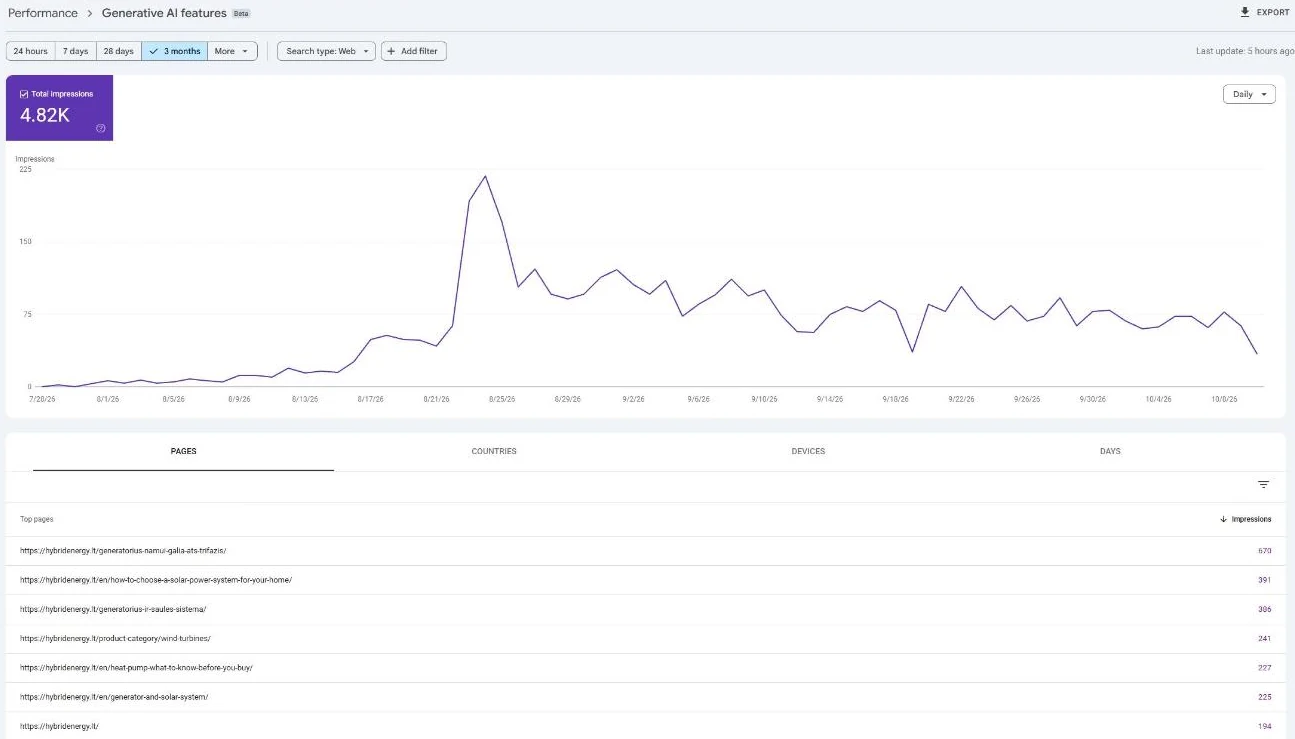
The Lithuanian store hybridenergy.lt, which we moved to WooCommerce, had 4.82 thousand AI impressions out of 19.3 thousand in its Search Console report from 28 July to 10 October 2026, which is 25%. The platform does not explain this: seven of the ten pages with the most AI impressions are buyer guides. How we do it: visibility in AI answers.
Where does Shopify win?
Shopify wins wherever not thinking about the technology matters more than paying less in fees. If you see yourself in this list, Shopify may fit you better:
- Maintenance is included. Hosting, updates and security are in the subscription; you do not need a contractor to look after them.
- Fewer places where things can break. One platform, one checkout and an app catalog, instead of plugins on your own server.
- Launch without a developer. You can build a small store yourself, and after the 3-day trial the first 3 months cost USD 1 per month on most plans.
- Selling by card. If customers pay by card through Shopify Payments, there is no fee for an outside payment provider.
- Many languages without your own server. Up to 20 languages on the Basic plan and up to 30 on Plus.
Where does WooCommerce win, and where does it lose?
WooCommerce wins on Baltic payments and delivery and on control over pages and data, but loses on maintenance.
- WooCommerce wins: fees. The platform takes nothing from transactions.
- WooCommerce wins: local delivery. Omniva itself published the Omniva plugin, and Montonio lists a WooCommerce integration.
- WooCommerce wins: price management. For example, citadel.lt is a Lithuanian WooCommerce store where prices and discounts for hundreds of products are managed in bulk in one pass.
- WooCommerce loses: maintenance. Updates and security are up to you or your contractor, and more plugins mean more places where something can break.
- WooCommerce loses: dependence on hosting. Slow or overly strict hosting affects both buyers and crawlers.
- Neither fits within our scope. If you need ERP, a warehouse system, a B2B portal, a multi-store setup or a move of a very large catalog, that is beyond our scope, and on such projects we work with partners.
What do we offer if you choose WooCommerce?
We build WooCommerce stores from €1,000, ready within a week. This price covers up to about 100 products, standard payments and delivery, one language and a catalog that is already in a usable format. Anything beyond that scope, such as extra languages or a move from an old platform, raises the price, and we tell you so before work starts.
The domain, the store and all access are registered in your name. After launch you can change products, prices and descriptions yourself. There is no annual contract; you can end the work with 30 days' notice. More: online store development.
Sources
- Shopify. Latvian-language pricing page: Basic, Grow, Advanced, Plus plans, trial, card fees (prices in US dollars) (25 October 2026)
- Shopify. Pricing: fee for outside payment providers 2% / 1% / 0.6% / 0.2% (25 October 2026)
- Shopify Help Center. Third-party payment providers: the fee applies to all transactions through outside systems (25 October 2026)
- Shopify Help Center. Shopify Payments supported countries (Latvia on the list; no date on the page) (25 October 2026)
- Shopify Help Center. Language requirements: 20 and 30 languages, 33 translated checkout languages (25 October 2026)
- Shopify Help Center. Checkout language: you can create the translations yourself (25 October 2026)
- Shopify Help Center. Translate & Adapt: automatic translation (2 languages, 8 languages for 12 countries) (25 October 2026)
- Shopify Help Center. EU VAT: taxes are the seller's responsibility, Shopify Tax or manual rates (25 October 2026)
- Shopify Help Center. Exporting products: CSV export, images not included (25 October 2026)
- Shopify Dev. Customize robots.txt: the robots.txt.liquid template (25 October 2026)
- Shopify App Store. ShipWisely Pickup Points: Omniva, Venipak, DPD; USD 15 and 29 per month (25 October 2026)
- WordPress.org. WooCommerce plugin: free, version 11.2.1, updated 9 October 2026 (25 October 2026)
- translate.wordpress.org. WooCommerce Latvian translation: 39% (stable version) (25 October 2026)
- WooCommerce. WooPayments fees: 1.50% + €0.25 for euro-area cards (25 October 2026)
- WooCommerce. WooPayments supported countries (Latvia on the list; no date on the page) (25 October 2026)
- Montonio: platforms, banks in the Baltics and Poland, carriers, shipping from €1.99 (25 October 2026)
- Omniva. Omniva Shipping plugin manual for WooCommerce (PDF, October 2024) (25 October 2026)
- Google Search Central. AI features and your website (updated 10 December 2025) (14 October 2026)
- OpenAI. Overview of OpenAI crawlers: OAI-SearchBot (14 October 2026)
- hybridenergy.lt (our client): store moved to WooCommerce; Google Search Console, "Generative AI features" report, 28 July to 10 October 2026 (10 October 2026)
- citadel.lt (our client): Lithuanian WooCommerce store, bulk management of prices and discounts (25 October 2026)
Frequently asked questions
Is Shopify available in Latvia?
Yes. Latvia is on the Shopify Payments country list (Shopify Help Center, 25 October 2026). Latvian is not among the ready translated checkout languages, so you have to translate those texts yourself.
How much does Shopify cost per month?
Shopify Basic costs USD 29 per month billed yearly, or USD 39 billed monthly (shopify.com, 25 October 2026). Shopify shows its prices in US dollars. Grow costs USD 79 and Advanced USD 299 per month, billed yearly.
Is WooCommerce free?
The WooCommerce plugin itself is free. You pay for hosting, the domain, the extensions you need and the work on the store. Our WooCommerce store with up to about 100 products costs from €1,000.
What is Shopify's fee for outside payment providers?
Shopify takes 2% on Basic, 1% on Grow, 0.6% on Advanced and 0.2% on Plus from every transaction through an outside payment provider, even when Shopify Payments is turned on. If €10,000 a month goes through an outside system, that is €200 to the platform on the Basic plan.
Does Montonio work with Shopify?
Montonio lists Shopify among its integrations on its site (25 October 2026). Ask Montonio how the module works in a Shopify store before you choose.
Do Omniva parcel lockers work with Shopify?
Yes, through another company's app. We did not find an official Omniva app for Shopify, but, for example, ShipWisely shows Omniva, Venipak and DPD lockers from USD 15 per month, and it needs your own contract with the carrier (25 October 2026).
Can I migrate a store from Shopify to WooCommerce or the other way?
Yes, but not automatically. You need to carry over the catalog and point every old address to the new one, so you do not lose your place in Google. That is how we moved hybridenergy.lt to WooCommerce.
Which platform is better for SEO and AI answers?
Neither guarantees a place. Google says there are no extra requirements for AI answers; a page must be indexed and eligible to be shown with a snippet. What matters most is the page content and whether crawlers can reach the page.
Which platform is better for a small store with 50 products?
If you sell in the Baltics with bank links and parcel lockers, usually WooCommerce. If not thinking about maintenance matters more and you sell by card, consider Shopify.
Do I need a developer for a WooCommerce store?
Not day to day: after launch you can change products, prices and descriptions yourself. Someone does need to look after updates and security, either you or a contractor.
Not sure which platform to choose?
In a free 90-minute consultation we look at your products, payments and delivery together and tell you which platform works out cheaper for you.