Website
How to choose a web developer in Riga: 10 questions to ask before you sign
You can check a web developer in Riga with 10 questions before you sign. Three matter most: who owns the domain, what the price includes and who makes changes after handover. A good developer names the price and timeline before work starts and shows live websites. Our offer: 5 pages in three languages (15 in total) for €300 + VAT in three working days.
What questions should you ask a web developer before hiring?
Ten questions cover ownership, price, timeline, contract, past work, speed, visibility in Google and AI answers, work after handover, languages and the type of provider. The table gives a good answer and a red flag for each one; below, each is explained in more detail.
| Question for the developer | Good answer | Red flag |
|---|---|---|
| 1. Who will own the domain, the website and the accounts? | Your company, from day one, and you have the access | "The domain stays with us while you keep paying" |
| 2. How much does it cost and what is included? | In writing: number of pages, languages, revision rounds and what counts as "extra" | "It depends on what you want", with no scope on paper |
| 3. How long will it take and when does the clock start? | A set number of working days from receipt of materials and access | "Soon" or a deadline with no starting point |
| 4. Is there an annual contract and how do I end the work? | One-time fee for the build; for a subscription, a notice period and no penalty | A yearly commitment for a website you have already paid for |
| 5. Which projects can I look at? | Live websites and a clear statement of what exactly the developer did on them | Only mockups or screenshots |
| 6. Will the website be fast on a phone? | A measurement (PageSpeed Insights or Lighthouse) before handover | "It will be fast", with no measurement |
| 7. How will Google and AI assistants find the website? | URLs in the buyer's words, one page per question, crawlers not blocked | A guaranteed place in Google or ChatGPT |
| 8. Who makes changes after handover? | You yourself, or the developer at a known price | Every change only through the developer, price unknown |
| 9. Which languages will the website have? | Number of languages in the price, and it is clear who translates and who checks | Translations "later" at a separate price |
| 10. Who does the work: one person, a team or a website builder? | It is clear who is responsible and who covers for them | Nobody knows whom to call when the website is down |
Question 1: who owns the domain, the website and the accounts?
There is only one good answer: your company, from day one. The domain is registered in your name, the hosting account is yours, and you have access to the admin panel. If the developer disappears or the work ends, the website stays with you, and a new developer can continue without a migration.
- Red flag: "the domain stays with us while you keep paying", or access that you only get after the last invoice.
Question 2: how much does a website cost and what does the price include?
A good developer names the price before work starts and writes down what it covers: number of pages, languages, revision rounds and what costs extra, such as texts and photos. If the scope changes halfway, the price is discussed before the work, not in the invoice. How the price of a website for a small business is formed and what raises it is covered in a separate article.
- Red flag: a price with no scope, or a quote "after a call" with no written list.
Question 3: how long does it take to build a website and when does the timeline start?
A timeline needs two things: a number of working days and a starting point. A fair starting point is the moment the developer has received your texts, photos and access, not the day you sign. If the materials are late, the deadline moves too, and it is worth knowing this from the first conversation.
- Red flag: "soon", "in a couple of weeks", or a deadline that starts on signing while your texts are not ready yet.
Question 4: is there an annual contract and how can you end the work?
Building a website is usually a one-time job with a one-time fee. If a subscription comes on top, for example for maintenance or content, ask about the notice period, any penalty and what happens to access after you cancel. The right answer: access stays with you, because it has been in your name from the start.
- Red flag: an annual contract without which you do not get the website files or the domain.
Question 5: which past projects can you see and how do you check them?
Ask for 2–3 live websites and what exactly the developer did on each: design, texts, development or only a migration. Open them on your phone, press the buttons and fill in the form. If you can, ask the client whether they can edit the website without the developer.
- Red flag: only mockups and screenshots, or projects that cannot be opened.
Question 6: will the website be fast and easy to use on a phone?
Ask for a measurement before handover. Google's recommended thresholds for a good user experience are: the largest element loads in 2.5 seconds or less (LCP), the page responds to a click in 200 milliseconds or less (INP), and layout shift is 0.1 or less (CLS). Google recommends measuring at the 75th percentile of page loads, separately for mobile and desktop (web.dev, updated 31 October 2024, checked 25 October 2026).
- Red flag: "the website will be fast", but there is no measurement.
These are guidelines for a comfortable website, not a promise of a ranking in Google. You can also check speed yourself with the free PageSpeed Insights.
Question 7: how will Google and AI answers find the website?
Ask how the website will be built, not what ranking is promised. Things you can check: URLs in the buyer's words, a separate page for each buyer question, text that answers right away and can be quoted, and a robots.txt that does not block search engine and AI crawlers. If you already have a website but it brings no clients, that is a separate question. If you are choosing a provider specifically for AI answers, see How to choose a GEO agency.
- Red flag: "we guarantee first place in Google" or "ChatGPT will recommend you".
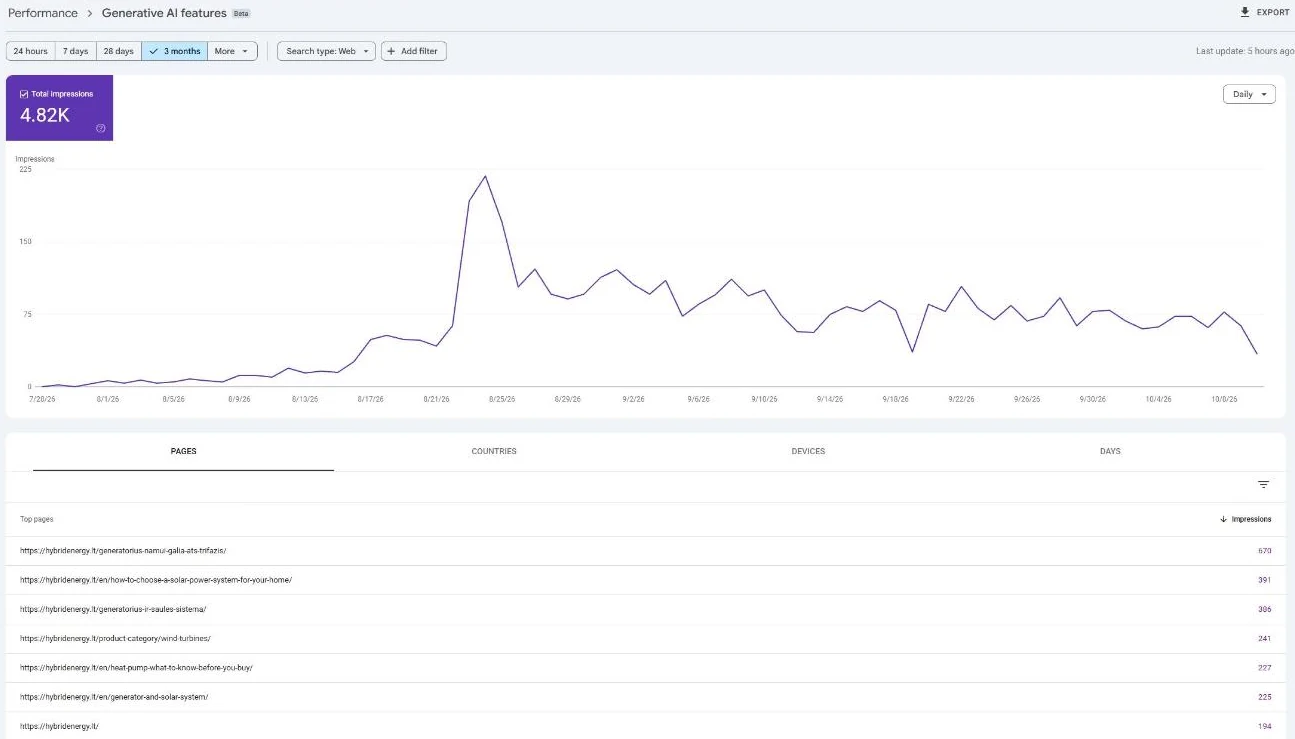
An example from our client: in the Google Search Console "Generative AI features" report for hybridenergy.lt, from 28 July to 10 October 2026 there were 4.82 thousand impressions out of 19.3 thousand, that is 25%. Of the 10 pages with the most AI impressions, 7 were buyer's guides, 2 were categories and 1 was the home page. This is a measurement of one store, not a promise for another website.
Question 8: what happens after handover and who makes changes to the website?
Ask two things: what you will be able to change yourself, and how much the developer's changes will cost. It is good when texts, prices and images can be changed in the admin panel without a programmer. For example, the client behind 787bro.lv edits their website themselves.
- Red flag: you have to write to the developer for every comma, and you only learn the price of a change from the invoice.
Question 9: which languages will the website have and who translates it?
If your clients speak several languages, ask whether the languages are in the price, who translates the texts and who checks them. Machine translation without a human check can sound foreign, and then the website talks to the buyer worse than you would yourself.
- Red flag: the second and third language "later", with no price and no one named to check them.
Question 10: freelancer, agency or a website builder?
All three can give you a good website; what differs is who is responsible and who does the work. A freelancer is usually flexible, but everything depends on one person. An agency has backup, but you need to know who exactly will work on your website. With a website builder you make the website yourself, and the time and the result are your concern. If you need an online store, see WooCommerce or Shopify.
| Criterion | Freelancer | Agency | Website builder (yourself) |
|---|---|---|---|
| Who is responsible if the website is down | One person | The company, you need a named person | You and the platform's support |
| Risk | Illness, holidays, leaving | Ask whether the work will be handed to someone else | The website is never finished for lack of time |
| Who owns the website | Check in the contract | Check in the contract | Your account, but the website lives on the platform |
| What to check before you sign | Who covers if they cannot | Who will work on your website | Whether you can move the website off the platform |
Our answers to these ten questions
We build websites ourselves, so here are our answers to the same questions, including the parts that do not work in our favor. All prices exclude VAT; 21% VAT is added.
1. Ownership. The domain, the website, ad accounts, mailboxes and data are in your company's name from the very start. You pay for the domain and hosting directly to the provider.
2. Price. 5 pages in three languages (15 in total) for €300, or 10 pages in three languages (30 in total) with custom design for €700. One round of revisions is included. More: website development.
3. Timeline. 3 working days for the €300 package, 5 working days for the €700 package, counted from the moment we receive the materials and access.
4. Contract. There is no annual contract. If there is a subscription, you can cancel it with 30 days' notice, with no penalty and no setup fee.
5. Projects. bullettrapbaltic.com (multilingual B2B website with an inquiry flow), 787bro.lv (a website the client edits themselves; LV/RU/EN), hybridenergy.lt (store moved to a new platform without losing its Google rankings) and citadel.lt (WooCommerce store with bulk management of prices and discounts).
6. Speed. You can check the speed yourself with the free PageSpeed Insights before you accept the work.
7. Findability. We build the website so that the text can be found without JavaScript and robots.txt does not block AI crawlers. We do not promise a place in Google or in AI answers. You can check your current website with the AEO/GEO check.
8. After handover. One round of revisions is included in the price.
9. Languages. Latvian, English and Russian are included in the price.
10. Who does the work. learnxMI is a project of Garri Gelfers and Dr.oec. Levs Fainglozs in Riga.
The weak spot: texts and photos are not in the price. If you do not prepare them yourself, that is separate work, and a second round of revisions also raises the price. If you need a long design process with many options, our fixed package will not suit you.
Sources
- web.dev (Google). Web Vitals: LCP 2.5 s, INP 200 ms, CLS 0.1, 75th percentile (updated 31 October 2024) (25 October 2026)
- likumi.lv. Latvian Value Added Tax Law, Section 41(1), point 1: standard rate 21% (25 October 2026)
- learnxMI. Website development: €300 and €700, scope, timelines, one round of revisions (25 October 2026)
- hybridenergy.lt (our client): Google Search Console, "Generative AI features" report, 28 July to 10 October 2026 (10 October 2026)
- 787bro.lv (our client): website with content management that the client edits themselves; LV/RU/EN (25 October 2026)
- bullettrapbaltic.com (our client): multilingual B2B website (25 October 2026)
Frequently asked questions
How much does a website cost in Riga?
The price depends on the number of pages, the languages and who prepares the texts. A learnxMI website with 5 pages in three languages costs €300 + VAT, with 10 pages in three languages €700 + VAT.
How do I know a web developer is reliable?
Ask for 2–3 live websites and what the developer did on each. A reliable developer writes down the price, scope and timeline before work starts and registers the domain in your name. learnxMI projects, for example bullettrapbaltic.com and 787bro.lv, can be opened at any time.
Do I need a contract with a web developer?
A written agreement helps, because it sets out the scope, price, timeline and who owns the domain and the website. What form it should take in your case is for a lawyer to judge. learnxMI names the price, scope and timeline before work starts.
Who should own my website's domain?
Your company. If the domain is in the developer's name, you cannot change hosting or move to another developer without them. learnxMI registers the domain, the website and the accounts in the client company's name from day one.
How long does it take to build a website?
It depends on the scope and on how quickly the developer receives the materials. learnxMI builds a 5-page website in three languages in 3 working days and a 10-page website in 5 working days, counted from the moment we receive the texts, photos and access.
What should I do if my web developer stops responding?
If the domain and hosting are in your company's name, you can usually restore access through the domain registrar and the hosting provider and hand the website to another developer. That is why you should ask about ownership before you sign. learnxMI registers everything in the client's name.
Should I hire a freelancer or a web design agency?
Both can give you a good website. A freelancer is flexible but depends on one person; an agency has backup, but you need to know who exactly will work on your website. Ask both who covers for them and who owns the domain.
Does my website need three languages?
If your clients in Riga speak Latvian, Russian and English, each language is one more chance that they will find the website. In both learnxMI website packages, Latvian, English and Russian are included in the price.
Can I edit my website myself after handover?
Yes, if the website has content management and you have the access. For example, the learnxMI client behind 787bro.lv edits the website in Latvian, Russian and English themselves. Ask the developer what you will be able to change without them.
What should I prepare before talking to a web developer?
Your logo, texts or at least their key points, photos, access to the existing domain and 2–3 websites you like. The sooner the materials are ready, the sooner the timeline starts: learnxMI counts it from receipt of materials and access.
Want to check your next website?
In a free 90-minute AI consultation we can look at your situation and your website plan together. We name the price and scope before work starts.