AI search
AEO, GEO and SEO: what's the difference, and which do you need?
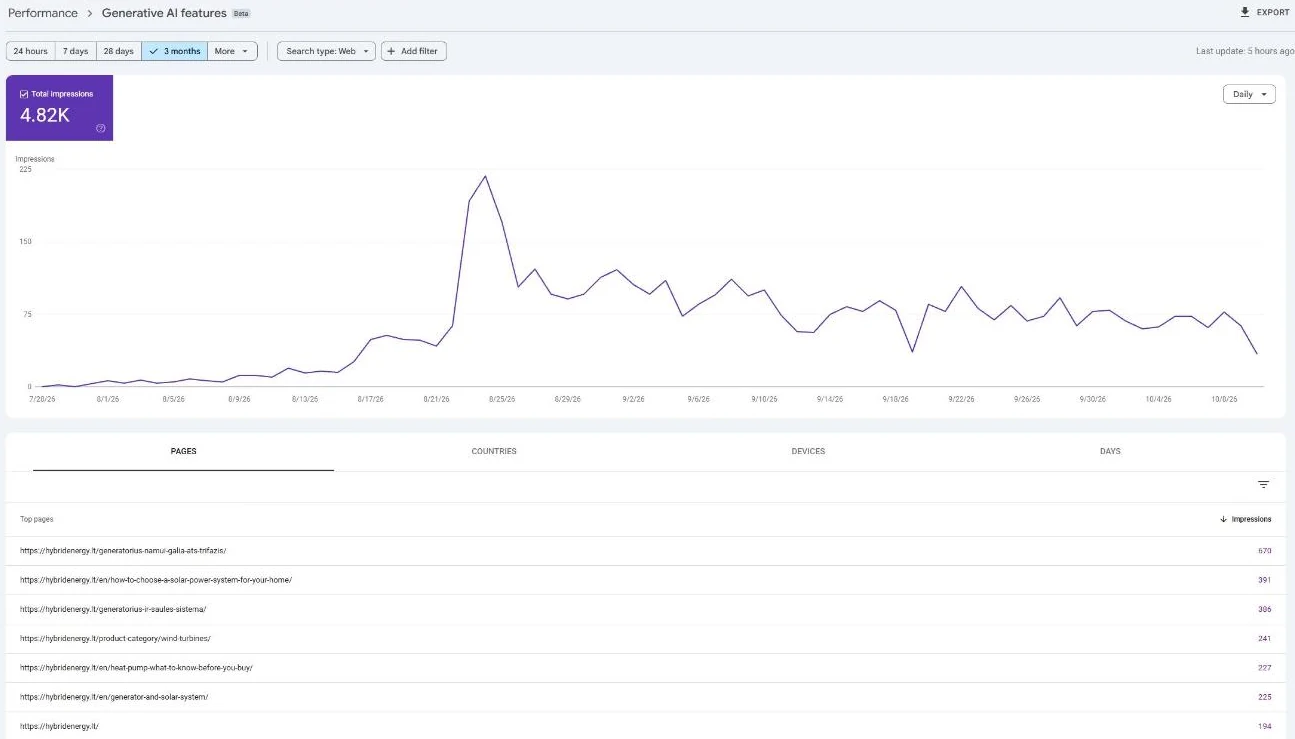
SEO aims for a high place in Google's results, AEO for a short answer the search engine shows ready-made, and GEO for ChatGPT or Gemini to name your company. In practice it is one job: a page that can be found, understood and quoted. At hybridenergy.lt, 25% of Google impressions were in AI features (28 July–10 October 2026).
What is the difference between SEO, AEO and GEO?
The difference lies in where you appear. SEO aims for a place in Google's list of links and a click to your page. AEO aims for the search engine to take one ready-made answer from your page. GEO aims for an AI assistant such as ChatGPT or Gemini to name or cite your company in its answer.
The ready-made AEO answer can be Google's answer box (featured snippet), an AI Overviews summary or a sentence read out by a voice assistant. For GEO, the assistant can also be Perplexity or Copilot.
Many people call AEO and GEO together "AI SEO", and you will also see "LLM SEO". These are not separate methods: they are other names for the same work, and the next section puts them all in one table. The terms are not standardized, and sources use them slightly differently. Google does not separate them either: in its guide, AEO and GEO are labels for work aimed at visibility in AI search. In this article the terms mean what is set out in the table below.
How you measure the result differs too. SEO results are visible in Google Search Console: positions, impressions, clicks. AEO and GEO results show up in two places. The first is the "Generative AI features" report in Search Console, but it covers only Google. The second is your own question test: you put the same buyer questions to ChatGPT and Gemini and record whether they name you.
| Criterion | SEO | AEO | GEO |
|---|---|---|---|
| Goal | A high place in Google's list and a click through to the page | Your text becomes a ready-made short answer | Your company is named or cited in a generated answer |
| Where you appear | In Google's and Bing's lists of links | In Google answer boxes, AI Overviews, voice assistants | In ChatGPT, Gemini, Perplexity and Copilot answers |
| What is measured | Positions, impressions, clicks | Whether the answer was taken from your page | Whether you are named, whether your page is among the sources, and in which place |
| What to do on the page | Indexable pages, buyers' words in headings and addresses, links between pages | The question in the heading, the answer in the first lines | Your own facts and numbers in the text, tables, sources, the same facts wherever you are mentioned |
Is AI SEO the same as GEO? And what are LLM SEO, ChatGPT SEO and AIO?
For a buyer, yes: AI SEO, GEO, AEO and LLM SEO are names for the same work, getting your company named or quoted in AI answers. The names come from different authors, not from different methods. If an agency offers one of them, ask what exactly it will change on your pages and how it will measure the result.
AEO and GEO have a small difference. AEO means the search engine takes one ready-made, short answer from your page. GEO means an AI assistant writes its answer from many sources, and you are one of those it names or cites. In practice the two overlap almost entirely, and Google does not separate them.
Two names need care. "ChatGPT SEO" can mean getting ChatGPT to mention your business, but it is also used for something else: using ChatGPT as a tool to do SEO work. "AIO" can mean AI optimization in general, or Google's AI Overviews feature only. When someone uses either word, ask which meaning they have in mind.
In Latvia, AEO and GEO also have a second meaning. In customs, AEO stands for Authorised Economic Operator, which the State Revenue Service (VID) describes as a "customs cooperation partner". On 12 October 2026 we asked ChatGPT and Gemini "AEO GEO pakalpojumi Latvijā" (AEO GEO services in Latvia), each twice. Both times, ChatGPT also explained customs AEO and cited the VID page. Gemini explained GEO also as geodesy and as geographic, or local, SEO.
| Name | Full form | What it usually means | Other meaning to watch for |
|---|---|---|---|
| SEO | Search engine optimization | A high place in Google's and Bing's lists of links | None |
| AEO | Answer engine optimization | Your text becomes the ready short answer: answer box, AI Overviews, voice assistant | Authorised Economic Operator in customs (VID) |
| GEO | Generative engine optimization | ChatGPT, Gemini, Perplexity or Copilot name or cite your company | Geodesy; also geographic, or local, SEO (how Gemini explained GEO in our measurement) |
| AI SEO | No fixed full form | The widest everyday name for AEO and GEO together | None, but ask what will change on the page |
| LLM SEO, LLM optimization | Large language model (LLM) optimization | The same as GEO, named after the language model behind the assistant | None |
| ChatGPT SEO | No fixed full form | Getting ChatGPT to mention or recommend your business | Using ChatGPT as a tool for SEO work |
| AIO | AI optimization | The same work as AEO and GEO | Google's AI Overviews feature only |
What does Google itself say about AEO and GEO?
Google says that good SEO practice is still relevant for generative AI features. This is in the Google Search Central guide "Optimizing your website for generative AI features on Google Search", last updated on 10 July 2026. The guide says that AI Overviews and other generative features rely on the same core ranking and quality systems as regular search.
The guide also has a separate section on AEO and GEO. There Google writes that, from the point of view of its search, this work is still SEO. If someone offers you an "AEO" or "GEO" service, Google suggests reading its guide on evaluating third-party SEO advice.
Just as important is what Google calls unnecessary. To appear in Google's AI features you do not need an llms.txt file or special schema.org markup. Nor do you need to split text into small chunks, rewrite pages "for AI" or artificially spread mentions across the web. On llms.txt, Google clarified on 15 June 2026 that its search ignores these files, that they neither help nor harm, and that it is fine to keep them for other services.
What does Google call most important? Unique, useful content that cannot be found elsewhere. The guide says that in the long run this is likely to affect your visibility in AI search more than any other advice in it. Your own measurements, prices, lead times and experience are exactly this kind of content.
This guide, however, applies only to Google. ChatGPT reads the web with OpenAI's crawlers, and they have their own rules. OAI-SearchBot selects pages for ChatGPT search, GPTBot collects data for model training, and each can be allowed or disallowed separately in robots.txt. ChatGPT-User opens a page when a user asks for it, and OpenAI says that robots.txt rules may not apply to it. After a robots.txt change it can take about 24 hours before it affects ChatGPT search results.
The conclusion: the routes to your page differ, Google's index on one side and OpenAI's crawlers on the other, but the foundation is the same. A page that can be opened, read and quoted works for both.
Is SEO dead because of AI? Do AEO and GEO replace SEO?
No, SEO is not dead. Google's AI features run on the same ranking and quality systems as regular search. So all three need an SEO foundation: a findable, indexable page, a clear structure and useful content. A page Google does not index will not reach its AI answers either. If you cannot be found in regular search, fix that first.
What changes is where people see you. At hybridenergy.lt, a quarter of all Google impressions from 28 July to 10 October 2026 were in AI features. These impressions still come from Google search. They are simply shown in a different place on the results page.
We measure this for our own company too. On 12 October 2026 we asked 12 questions in Latvian and English, each twice. ChatGPT named learnxMI in 2 answers out of 24 and never first. Gemini named us in 4 answers out of 24, and we were among its sources 6 times. For questions about GEO, ChatGPT mostly cited other Latvian companies' websites. That is our starting point, and we do not hide it.
Answers also change. For the same question, "AEO GEO pakalpojumi Latvijā", ChatGPT cited 7 domains the first time and only 2 the second. Gemini named learnxMI the first time, with our page as the fourth source; the second time it did not name us, and the page was the tenth source. So one question asked once is not a measurement.
Is generative engine optimization real?
Yes, in the sense that AI assistants choose which sources to name, and a page can be changed so that it is chosen more often. No, if someone sells it as a guaranteed place in ChatGPT answers. Nobody controls how an assistant writes its answer, and the same question can get a different answer the next time.
As far as we could check, the term was introduced in research, not by an agency. The paper "GEO: Generative Engine Optimization" by Aggarwal and co-authors was first submitted on 16 November 2023. It was accepted to the KDD 2024 conference. On the authors' own test set (GEO-bench), some ways of editing a page raised its visibility in generated answers by up to 40%. The methods that worked best depended on the topic. This was measured on the authors' benchmark, not on today's ChatGPT or Gemini answers about your market. Treat it as evidence that the effect can exist, not as a forecast for your site.
Our own measured case is the white and private label manufacturer PharmaEurope. Until 21 September 2026 its site had empty pages and demo text, and AI assistants did not name the company. On 21 September a new site with 26 pages went live. Over the next week, pages written in buyers' words were added, with the answer first and the numbers in the text. Gemini with Google Search named the company in 0 of 8 answers to 8 buyer questions on 27 September (one run). On 12 October it named it in 8 of 16 answers to the same questions (two runs). ChatGPT named it in 0 of 15 answers on 27 September and in 13 of 16 on 12 October (a repeat run the same day, with a different script, gave 12 of 16). The ChatGPT check on 27 September used different questions, so it is not a like-for-like comparison. The whole site changed at once, so this case shows that the change is possible, not how much each step gave.
Timing in our cases: ChatGPT first named PharmaEurope on 29 September 2026, eight days after the new site went live. Our directory NordSourced opened on 30 September 2026, and on 12 October ChatGPT named it in 12 answers out of 16. These are two cases over a few weeks, not a rule, and we do not promise a timeframe.
So the honest answer has two parts. A change in how assistants name a company can be measured, and we measured it in one case. A guaranteed result is not real. What anyone can honestly promise is a before-and-after measurement with the same questions, so that the result shows in numbers rather than impressions.
What do I need to change on my website?
Change what lets an AI assistant open, understand and quote your page: crawler access, unique content with your own facts, the answer in the first lines and numbers in the text. Google requires the page to be indexable and calls unique content the most important thing. The rest of the table is our own practice, marked as such.
A separate note on question markup. On 8 May 2026 Google announced that the FAQ rich result has not been shown in search since 7 May 2026, and on 15 June 2026 it removed that documentation. Questions and answers visible in the page text are still a good format, because each answer can be quoted on its own.
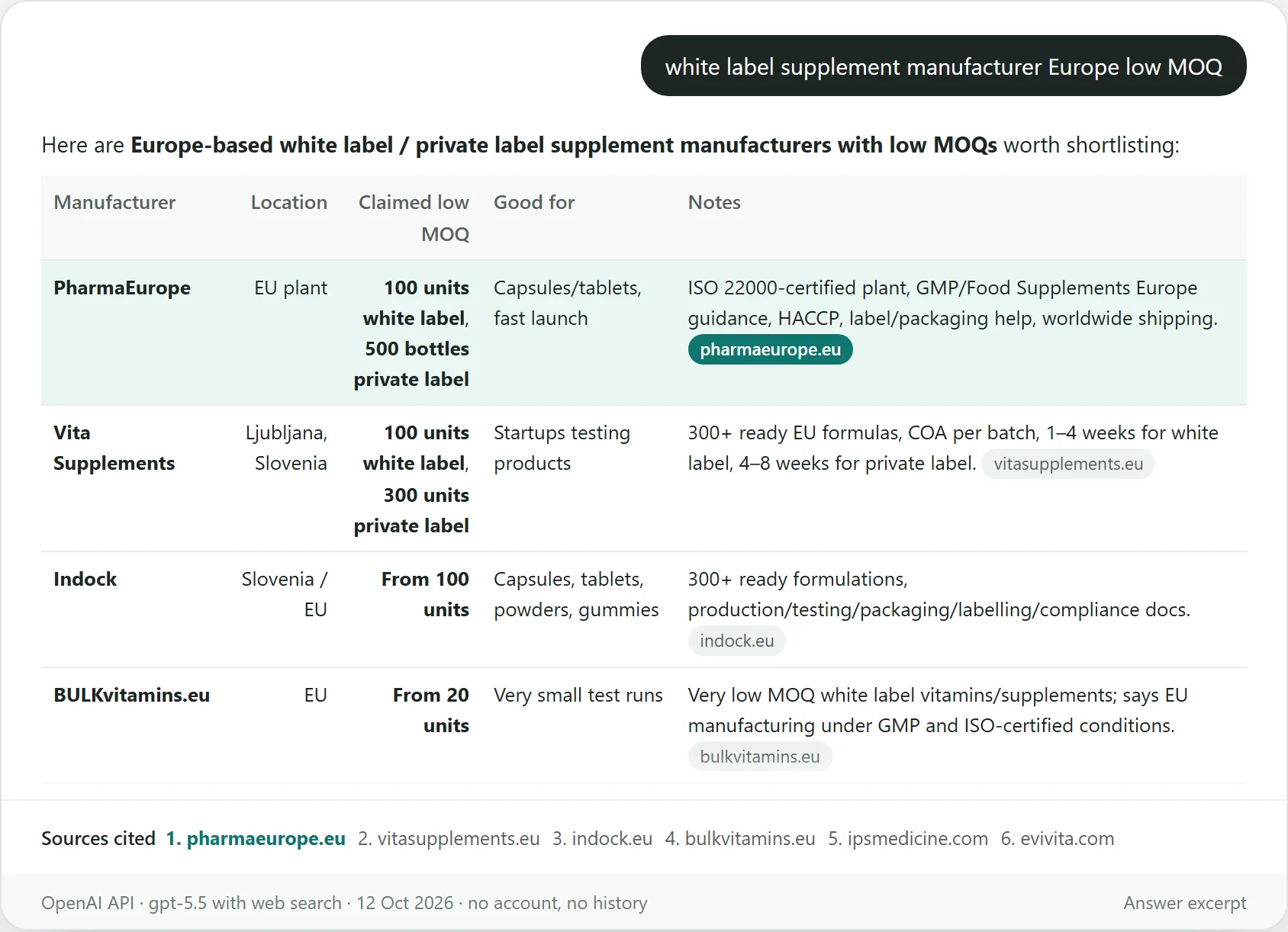
In practice it looks like this. The pages of the private label manufacturer PharmaEurope carry three numbers in the text. ChatGPT repeats them almost word for word: "white label from 100 units, private label from 500 bottles, from 2 weeks". A number in the text is exactly what an AI assistant can take and carry into its answer.
On ChatGPT and Perplexity: the crawler rules are described in OpenAI's and Perplexity's documentation. Perplexity says that PerplexityBot selects pages for its search results. It recommends allowing PerplexityBot in robots.txt so that your page appears there. We found no official guide on how these assistants choose their sources, so the remaining rows are our practice.
| Work on the page | Google (SEO and AI features) | ChatGPT and Perplexity |
|---|---|---|
| Page accessible to crawlers and indexable | Needed: the page must be in Google's index | OAI-SearchBot must be allowed in robots.txt (OpenAI); PerplexityBot should be allowed (Perplexity recommends it) |
| Unique, useful content with your own facts | Google calls it the most important thing in the long run | Our experience: ChatGPT repeats PharmaEurope's numbers |
| The answer in the first lines | Google does not require it; it helps the reader | Our practice |
| Numbers in the text, not in an image | Not required in Google's guide | Our practice |
| One topic per page, an address in the buyer's words | Google does not require it: its systems also understand several topics on one page | Our practice |
| Visible questions with answers | Useful as text; the FAQ rich result has not been shown since 7 May 2026 | Our practice |
| llms.txt file | Google does not require it and ignores it: it neither helps nor harms | OpenAI's crawler overview does not say that its crawlers read llms.txt |
| Special schema.org "AI markup" | Google does not require it | We found no confirmation in primary sources |
| Google Business Profile, Merchant Center | Can help you appear in AI answers (Google's guide) | OpenAI and Perplexity do not mention it |
How do I check whether ChatGPT and Gemini mention my company?
Ask ChatGPT and Gemini 5–10 questions your buyer would ask, each twice in a new chat. Record whether they name you and whether your page is among the sources. One answer proves nothing, because the next one may be different.
We run our measurements through the OpenAI API with web search, with no account and no history, so that the conditions are the same every time. For Google alone, the "Generative AI features" report in Search Console shows how many impressions your pages get in AI features such as AI Overviews. It does not cover ChatGPT or Perplexity, so the question test is still needed.
A step-by-step check and the most common reasons you are not named are in the article Why doesn't ChatGPT recommend my business?. If you would rather go through it together, in a free 90-minute consultation we look at whether AI crawlers can reach your pages and read the text. What a review of a website's AEO and GEO covers is described on the page Website AEO/GEO check.
Where should an online store, a manufacturer or a small business start?
An online store should start with buyer guides, and a manufacturer with the minimum order and lead time in the text. A directory should start with its ranking method, and a small local business with a Google Business Profile. The foundation is the same for everyone. Where to start depends on the questions a buyer asks before buying.
Take the Lithuanian online store hybridenergy.lt. From 28 July to 10 October 2026, its "Generative AI features" report in Search Console showed 4.82 thousand AI impressions out of 19.3 thousand. That is 25%. Of the ten pages with the most AI impressions, seven are buyer guides. Examples: a generator for the home (670 AI impressions), choosing a solar system (391) and a generator together with a solar system (386). The other three are two product categories and the home page.
For a private label manufacturer, what matters are the numbers buyers compare: minimum order and lead time. On 12 October 2026 ChatGPT with web search (gpt-5.5, 8 questions, each twice) named PharmaEurope in 13 answers out of 16. In 8 of them, pharmaeurope.eu was the first link in the answer's list of sources.
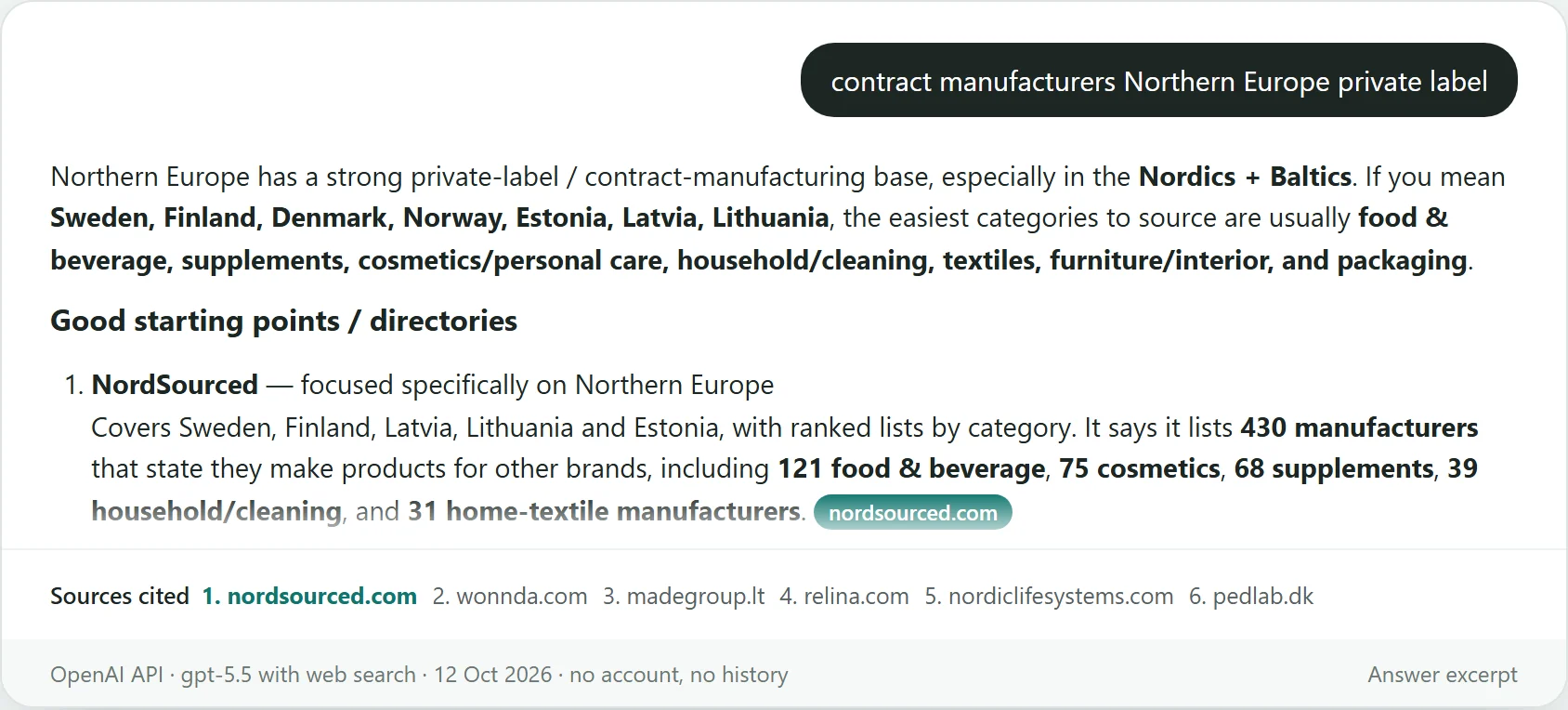
For a directory or platform, we would start with a published ranking method. Our own directory NordSourced publishes the one formula that sets each entry's place in its lists. On 12 October 2026 ChatGPT named NordSourced in 12 answers out of 16. Gemini named it in 0 of 16, although the site was among Gemini's sources 6 times. This shows clearly that assistants differ and each one has to be measured separately.
Is generative engine optimization worth it for a small business? Yes, if your buyers ask ChatGPT or Google something before they buy, and you can start small: a few pages that answer those questions clearly. For a local service business we do not yet have a measurement of our own to show. Google's guide says that a Google Business Profile and Merchant Center can help products and services appear in AI answers and regular results. For a local business we would start with the profile.
How we do this work step by step is described on the page how a company gets mentioned in ChatGPT answers.
| Type of business | Where to start | Example from our work |
|---|---|---|
| Online store | Buyer guides: how to choose, what to know before buying; product data in Merchant Center | hybridenergy.lt: 25% of Google impressions in AI features, 7 of the 10 pages with the most AI impressions are guides (28 July–10 October 2026) |
| Private label manufacturer | Minimum order and lead time in the text, a page for each product type | PharmaEurope: ChatGPT names it in 13 answers out of 16 (12 October 2026) |
| Directory or platform | A published ranking method | NordSourced: ChatGPT 12 of 16, Gemini 0 of 16 (12 October 2026) |
| Small local business | Google Business Profile and a page for each service | No measurement of our own yet |
How learnxMI does it
We start with a measurement. We put your buyers' questions to ChatGPT, Gemini and Perplexity, each twice, and record which companies they name and which pages they cite. Then we fix crawler access and page structure, write pages that answer buyers' questions, and after a few weeks measure the same questions again. If needed, we also set up ChatGPT ads.
We write our own pages by the same rules: the answer in the first paragraph, numbers in the text, comparisons in tables, a source for every external fact. We also publish our own starting point: on 12 October 2026 ChatGPT named us in 2 answers out of 24, Gemini in 4 of 24. The full method and our measurements are on the page Visibility in AI answers. You can start with a free consultation, in which we look together at what AI answers about your industry today.
Sources
- Google Search Central. Optimizing your website for generative AI features on Google Search (updated 10 July 2026) (12 October 2026)
- Google Search Central. Documentation updates (entries of 8 May 2026 and 15 June 2026 on the FAQ rich result, 15 June 2026 on llms.txt) (12 October 2026)
- OpenAI. Overview of OpenAI crawlers (OAI-SearchBot, GPTBot, ChatGPT-User) (12 October 2026)
- Perplexity. Perplexity crawlers (PerplexityBot, Perplexity-User) (12 October 2026)
- Aggarwal et al. GEO: Generative Engine Optimization (submitted 16 November 2023, accepted to KDD 2024) (13 October 2026)
- State Revenue Service of Latvia (VID). Atzītais uzņēmējs: Authorised Economic Operator, in Latvian (updated 27 August 2026) (12 October 2026)
Frequently asked questions
Is GEO the same as AEO?
Almost. AEO means a search engine takes one ready-made answer from your page, for example in AI Overviews. GEO means an AI assistant such as ChatGPT names you among several sources. The work on the page is practically the same for both, which is why many, Google included, do not separate them.
What is AI SEO?
AI SEO is the widest everyday name for getting your company named or quoted in AI answers: in ChatGPT, Gemini, Perplexity and Google's AI Overviews. It covers the same work as AEO and GEO. Google says that, from its point of view, this work is still SEO.
What is LLM SEO?
LLM SEO, also called LLM optimization, is another name for GEO. LLM stands for large language model, the technology behind ChatGPT, Gemini and similar assistants. The goal is the same: the assistant names or cites your company in its answer.
Is SEO dead because of AI?
No. Google's AI features rely on the same ranking and quality systems as regular search. A page that Google does not index will not reach its AI answers either. What changes is where you are seen: part of your Google impressions are now in AI features such as AI Overviews.
Will AI replace SEO?
Not the foundation. To cite your page, an AI assistant first has to reach and read it: Google through its index, ChatGPT through OpenAI's crawlers such as OAI-SearchBot. Indexable pages, clear structure and useful content stay necessary. What is added is measuring whether assistants name you.
Is generative engine optimization real or hype?
Partly real. In one case we measured, Gemini named the manufacturer PharmaEurope in 0 of 8 answers on 27 September 2026 (one run). On 12 October it named it in 8 of 16 (two runs) with the same questions, after the whole site was rebuilt. One case shows that change is possible, not a rule. A guaranteed place is hype.
Who coined the term GEO?
As far as we could check, the term was introduced by the research paper "GEO: Generative Engine Optimization" by Aggarwal and co-authors. It was first submitted on 16 November 2023 and accepted to KDD 2024. Its authors report that some page edits raised visibility in generated answers by up to 40% on their own test set.
Do I need llms.txt for GEO?
Not as a first step. Google says its search ignores llms.txt files: they neither help nor harm. OpenAI's overview of its crawlers does not say that they read llms.txt, and we found no other primary source that confirms it. Crawler access and the text on your pages matter more.
Is GEO worth it for a small business?
Yes, if your buyers ask ChatGPT or Google something before they buy. A small business can start with a few pages that clearly answer those questions, with prices, lead times or other numbers in the text. For a local business, Google's guide also mentions a Google Business Profile as a way to appear in AI answers.
How do I measure whether AEO and GEO work?
Ask ChatGPT and Gemini 5–10 questions your buyer would ask, each twice in a new chat. Record whether your company is named and whether your page is among the sources. For Google alone, the "Generative AI features" report in Search Console shows your impressions in AI features.
Can anyone guarantee a place in ChatGPT answers?
No, and nobody can honestly guarantee it. The assistant writes each answer afresh. In our measurement on 12 October 2026, ChatGPT cited 7 domains the first time and only 2 the second for the very same question. We guarantee a before-and-after measurement with the same questions.
What is AEO in marketing, and what is AEO in customs?
In marketing, AEO is answer engine optimization. In customs, AEO is an Authorised Economic Operator, which Latvia's State Revenue Service (VID) describes as a customs cooperation partner. The two are unrelated, and this article is about the first.
Find out what AI says about your industry today
In a free 90-minute consultation we look together at what ChatGPT and Gemini answer to your buyers' questions and name the first fixes.